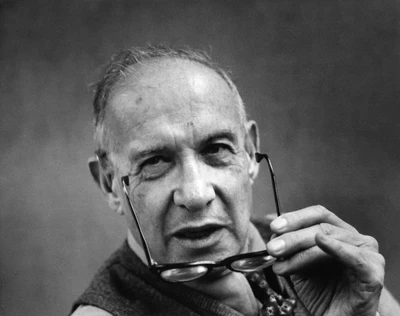
Peter Drucker
🇺🇸Peter Drucker (1909–2005) was an Austrian-American management consultant, educator, and author, widely regarded as the founder of modern management. He played a pivotal role in establishing management as a systematic discipline and served as a professor of social science and management at Claremont Graduate University.
He authored 39 books, including "The Practice of Management" and "The Effective Executive," laying the conceptual foundations for the modern business corporation. Drucker is credited with inventing the concept of management by objectives (MBO) and predicting major societal shifts such as the rise of the knowledge worker.
His writings offered profound insights into how humans organize themselves across business, government, and non-profit sectors to achieve performance. He was awarded the Presidential Medal of Freedom in 2002 and remains one of the most influential thinkers in the history of management.
Quotes
The entrepreneur always searches for change,
responds to it,
and exploits it as an opportunity.Uncertainty is often feared, yet it remains the most fertile ground for innovation. Real progress happens when we stop resisting shifts and start using them to build something new.
People who don’t take risks generally make about two big mistakes a year.
People who do take risks generally make about two big mistakes a year.Playing it safe offers no guarantee against failure, so you might as well chase what matters. It serves as a liberating reminder that mistakes are an inevitable constant, not a penalty reserved only for the bold.
Knowledge has to be improved, challenged, and increased constantly,
or it vanishes.Insight is not a permanent possession but a fleeting state that demands continuous effort to maintain. Without the friction of new challenges, even hard-won wisdom quietly slips away.
The greatest danger in times of turbulence is not the turbulence—
it is to act with yesterday’s logic.Clinging to familiar patterns often poses a greater threat than the uncertainty itself. It challenges us to adapt our mindset rather than simply enduring the storm.
There is nothing so useless
as doing efficiently that which should not be done at all.Efficiency without purpose is a waste of energy. It serves as a sharp reminder to question the necessity of a task before obsessing over how to speed it up.
Efficiency is doing better
what is already being done.Refining existing habits is often more impactful than constantly chasing new ones. It serves as a grounded reminder to focus on optimization rather than reinventing the wheel.
What gets measured
gets managed.Quantifying your reality is the first step toward mastering it. When progress feels stagnant, concrete metrics often provide the clarity needed to move forward.
The purpose of business is to
create and keep a customer.Profit acts as a scorecard, but the existence of any venture depends entirely on those it serves. Remembering this fundamental truth cuts through the noise of complex strategies and metrics.
Management is doing things right;
leadership is doing the right things.Focusing solely on efficiency can obscure the bigger picture of where you are actually heading. It highlights the crucial distinction between executing tasks well and choosing the path that matters.
The best way to predict the future
is to create it.When the uncertainty of tomorrow feels overwhelming, shifting from passive anticipation to active construction restores a sense of agency. It serves as a reminder that the surest path forward is the one you build yourself.